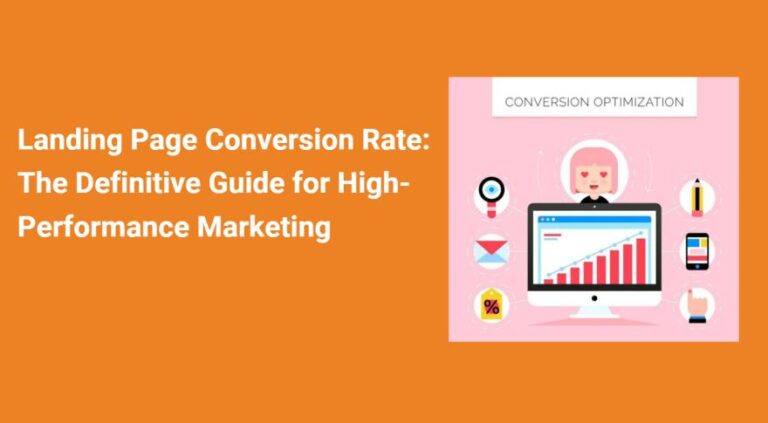
A landing page is more than a digital touchpoint—it is the decisive moment where attention either converts into measurable business value or disappears. The landing page conversion rate sits at the center of this moment. It reflects the clarity of your offer, the strength of your message, and the credibility of your brand. For businesses investing in paid traffic, SEO, email nurturing, or product launches, few metrics are as critical to long-term ROI as mastering this one.
What Is a Landing Page Conversion Rate?
A landing page conversion rate is the percentage of visitors who complete the primary action your page is designed to achieve. Unlike general website behavior—where users explore navigation menus, blog content, and multiple entry points—a landing page serves one mission. It asks the visitor to make a decision: sign up, request a quote, subscribe, download, or purchase. Because the objective is singular, the conversion rate becomes a direct measure of how convincingly your brand communicates value.
A strong conversion rate indicates that your messaging, offer, and user experience align with user expectations. A weak rate signals friction—whether in clarity, trust, design, or audience targeting.
Ecommerce Landing Page Conversion Rate
In ecommerce, the conversion action is typically transactional. Users may be adding an item to their cart, redeeming an offer, entering their email for a discount, or completing a purchase. These decisions rely heavily on trust and clarity. Visitors want to understand product benefits, see authentic reviews, evaluate pricing, and identify any risks such as unclear shipping or return policies. An ecommerce landing page that simplifies these factors naturally achieves higher conversions than a traditional product page crowded with distractions.
Brand reputation, perceived value, mobile experience, and page speed all play decisive roles. A well-engineered ecommerce landing page removes doubt and leads the user toward a confident purchase decision.
How to Calculate Landing Page Conversion Rate

The formula is simple:
Conversion Rate = (Total Conversions ÷ Total Visitors) × 100%
If 1,200 people visit your landing page and 72 complete the intended action, your conversion rate is 6%. While the math itself is straightforward, the accuracy depends on consistent measurement. Many marketers track unique visitors instead of sessions to avoid skewed data. The definition of a “conversion” must also remain tightly aligned with the page’s core objective. Precision here ensures that optimization decisions are based on reliable, actionable data.
What Is a Good Landing Page Conversion Rate?
Context determines what “good” means. Conversion benchmarks vary widely across industries, channels, and stages of the customer journey. A landing page targeting high-intent users—such as branded search traffic or existing email subscribers—will naturally outperform pages receiving colder or more exploratory traffic.
Rather than chasing generic averages, high-performing teams evaluate conversion rate in relation to offer strength, traffic quality, and historical performance. A page offering a free resource may convert significantly higher than one selling a premium product. The goal is not to match an industry benchmark but to consistently outperform your previous baseline.
How to Improve Landing Page Conversion Rate
1. Strengthen Your Value Proposition
Every high-converting landing page begins with a value proposition that is unmistakably clear. Within the first few seconds, visitors should be able to understand exactly what you offer and why it matters. This starts with a simple, benefit-driven headline supported by concise subtext that reinforces the core promise.
Ambiguous or feature-heavy language dilutes impact. What works better is clarity—showing how the product or service solves a problem, improves workflow, or creates measurable benefit. The stronger and more immediate the perceived value, the more willing users are to take action.
2. Optimize the Page Structure and Visual Hierarchy
Once the message is clear, the layout must guide the visitor toward the call to action without distraction. Effective landing pages use visual hierarchy intentionally—bold headlines, strategic spacing, and a layout that moves the eye naturally from introduction to decision point.
Clean design consistently outperforms visually complex pages. Minimizing navigation, reducing competing elements, and presenting information in a sequential flow allows users to focus on the intended action. This is especially important for mobile devices, where attention span and screen space are limited.
3. Build Trust With Proof and Transparency
Conversion is a matter of confidence. Visitors need assurance that the offer is legitimate, safe, and valuable. Elements such as testimonials, star ratings, case results, guarantees, refunds, certifications, or security badges provide social proof and reduce perceived risk.
For ecommerce, transparency around shipping, returns, and pricing plays a critical role. For B2B lead generation, credibility often comes from industry authority, use cases, and clear statements of expertise. The more quickly trust is established, the shorter the user’s decision-making cycle becomes.
4. Improve Technical Performance and Load Speed

Even the strongest offer will underperform if the page loads slowly. Page speed directly correlates with conversion rate, and modern users make judgments in milliseconds. Compressing images, reducing scripts, optimizing hosting, and applying lightweight design practices all contribute to a smoother experience.
Mobile performance is particularly critical. A page that loads in two seconds on desktop but lags on mobile will still lose conversions. Technical friction is often invisible but has a measurable impact.
5. Clarify and Enhance the Call to Action (CTA)
Your CTA is the final moment of persuasion. It should be visually prominent, easy to understand, and aligned with the value proposition. The wording matters—actionable, benefit-oriented CTAs consistently outperform generic ones. The placement matters as well; a well-positioned CTA above the fold, followed by reinforcing CTAs farther down, creates natural conversion opportunities without overwhelming the visitor.
Small shifts in wording or layout often create meaningful improvements, especially when the offer is strong.
6. Use A/B Testing to Continuously Refine the Page
Optimization does not end after publishing. The highest-performing landing pages are built on continual experimentation. A/B testing removes guesswork by comparing two versions of a page—headlines, images, CTA styles, layout patterns, or even different offers.
Over time, consistent testing reveals patterns: what your audience responds to, what confuses them, and what motivates action. This data-driven approach compounds results and ensures your landing page remains competitive as user expectations evolve.
Common Reasons Landing Pages Fail to Convert
Many landing pages underperform due to predictable friction points. Overwhelming text, vague promises, or confusing CTAs force users to think harder than they should. Slow mobile performance and cluttered layouts interrupt the decision-making process. Inconsistent messaging between ads and landing pages also reduces trust and discourages action. Correcting these issues often leads to immediate, measurable gains.
Tools That Help Measure and Optimize Conversion Rate
Effective conversion optimization relies on insight. Platforms such as Google Analytics reveal user behavior trends, while heatmap and session replay tools expose areas where users hesitate or abandon the journey. Modern landing page builders equipped with A/B testing and performance analytics provide marketers with powerful capabilities to optimize at speed and scale.
FAQs
What is a landing page conversion rate?
It is the percentage of visitors who complete the primary action a landing page is built to encourage.
What is an ecommerce landing page conversion rate?
It measures how effectively ecommerce-focused landing pages drive actions such as add-to-cart behavior, discount redemptions, and purchases.
How is landing page conversion rate calculated?
Divide total conversions by total visitors and multiply by 100.
What qualifies as a good conversion rate?
Performance varies by industry and traffic type, but strong landing pages consistently exceed website-wide averages and improve over time through testing.
Does traffic quality impact conversion rate?
Yes—targeted, high-intent traffic consistently converts at higher rates than broad or cold audiences.
How frequently should I optimize a landing page?
Optimization is continuous. The more traffic a page receives, the more frequently it should be tested and refined.
Conclusion
A landing page conversion rate is more than a marketing metric—it is a direct reflection of your brand’s ability to persuade, reassure, and deliver value at the exact moment a user decides to act. By understanding the fundamentals, focusing on clarity and trust, and embracing a culture of ongoing optimization, marketers can transform landing pages into reliable engines of growth. In an environment where customer attention is scarce and acquisition costs continue to rise, improving your conversion rate isn’t just beneficial—it’s essential.