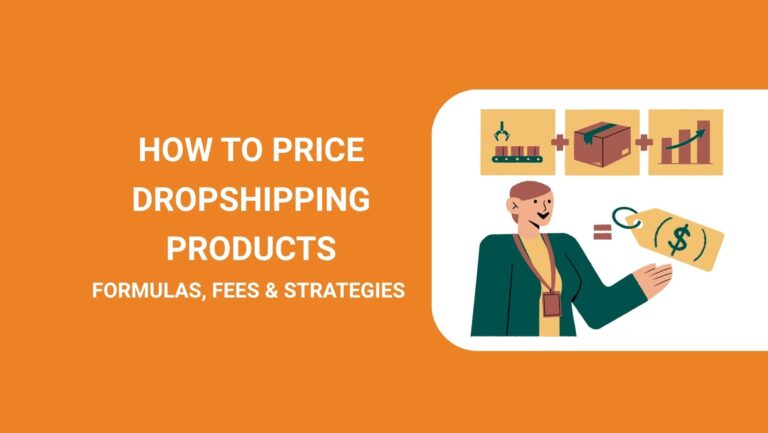
To price dropshipping products profitably, we start with the landed cost of getting one unit to the customer, then account for payment fees, advertising, and a refund buffer. From there, we work backward from the profit margin we want while checking whether our customer acquisition cost (CAC) still leaves enough room for profit.
Quick Answer: Our 3-Step Dropshipping Pricing Formula
- Landed Cost = Product Cost + Shipping + Duties + Fulfillment Fees
- Floor Price = (Landed Cost + Fixed Fees) ÷ (1 − Target Margin − Payment Fee %)
- Break-Even CAC = Selling Price − Landed Cost − Fees − Refund Buffer
The third number is especially important. It tells us the most we can afford to spend to acquire a customer before the order stops being profitable.
Quick Facts
- A useful planning target for net profit margin is around 15–25%.
- We generally want a 40–60% pre-ad gross margin so there is room for acquisition costs.
- Standard U.S. card processing can be around 2.9% + $0.30 per transaction, although rates depend on your processor and account.
- For initial price testing, 3–5× sourcing cost is often used for paid-traffic products, while 2–2.5× can be a starting point for organic traffic.
- These multipliers are only shortcuts. Your landed cost and break-even CAC should ultimately decide whether the price works.
If you’re still learning what dropshipping is, it helps to understand the fulfillment model before working through the numbers. Your sourcing arrangement matters too, since a dropshipping agent can affect both the product and fulfillment costs that go into your landed cost.
Understanding Dropshipping Economics

Dropshipping is an e-commerce business model where you, as an online store owner, act as a middleman between wholesale suppliers and customers.
In this model, you don’t need to worry about inventory management and fulfillment, which can be a significant advantage to new entrepreneurs.
As a dropshipper, your main duties include setting up your online store, showcasing products sourced from wholesale suppliers, and focusing on marketing and customer service.
However, to run a successful dropshipping business, it’s essential to understand the economics behind it.
One of the most important aspects of dropshipping economics is your cost structure, which consists of product costs, shipping fees, and platform fees. Let’s discuss how each component affects your dropshipping business:
Product Costs
These are the costs you pay to your vendors for the products you sell in your online store.
You need to purchase items at a wholesale price, which allows you to sell them at a higher retail price to your customers.
The difference between the wholesale price and the retail price is your profit margin.
Shipping Fees
Since you’re not handling fulfillment and logistics yourself, your vendors handle shipping your products to your customers.
Shipping costs are typically included in the product cost, but you need to keep track of them to ensure you’re still making a profit after all fees are accounted for.
Platform Fees
If you’re using an e-commerce platform to create and run your online store, you’ll usually need to pay a monthly subscription fee.
Costs vary depending on the platform, its features, and your store’s requirements. Examples of popular e-commerce platforms are Shopify, WooCommerce, and BigCommerce.
The Real Cost of a Dropshipping Product

When we price a product, we never start with the supplier quote alone. A $9 factory price does not mean the product costs us $9 to deliver.
The number that matters is the landed cost: what it costs to source, ship, prepare, and fulfill one unit before payment fees, advertising, and refunds enter the picture.
A typical cost stack includes:
- Product cost: the factory or supplier quote
- International shipping: ideally calculated per unit
- Duties and import charges: depending on the product, destination, and current import rules
- Packaging and fulfillment: custom packaging, inserts, pick-and-pack, or other handling costs
- Payment fees: charged when the customer pays
- Refund/chargeback buffer: an allowance for orders that do not remain profitable
- Customer acquisition cost (CAC): what it costs to generate the sale
At the factory-quote stage, it is worth getting the full delivered-cost picture rather than comparing supplier prices in isolation. A product sourcing agent can help compare the product, shipping, and fulfillment costs together.
Worked Example: From a $9 Factory Quote to the Real Cost per Sale
Suppose we are evaluating a product from China for a US dropshipping store:
| Cost Layer | Amount | What It Means |
| Factory quote | $9.00 | Price of one unit from the supplier |
| International shipping | $4.50 | Per-unit shipping cost |
| Packaging + fulfillment | $1.00 | Handling, packaging, and order processing |
| Duties/import charges | Varies | Check the product classification and current rules for the destination market |
| Landed cost before applicable duties | $14.50 | Our starting cost before payment fees, refunds, and marketing |
| Selling price | $39.99 | Example retail price for testing |
| Payment processing | $1.46 | Illustrative at 2.9% + $0.30 |
| Refund buffer | $2.00 | 5% allowance used for this example |
| CAC | $10.00 | Example cost to acquire one customer |
| Contribution left | $12.03 | Before store overhead and taxes |
This is why a product that looks like it has a $30.99 spread between its $9 factory quote and $39.99 selling price does not have $30.99 of profit. Once the rest of the cost stack is included, the economics look very different.
Watch the Volumetric Weight Trap
Shipping is one of the easiest costs to underestimate. Carriers may charge based on volumetric weight when a package takes up more space than its actual weight would suggest.
That means a lightweight but bulky product can cost more to ship than a smaller, heavier item. When we compare sourcing options, we therefore look at the packed dimensions as well as the unit weight. A small change in packaging size can sometimes change the shipping economics enough to affect the viable retail price.
Duties require the same care. They depend on factors such as the product’s classification and destination, and import policies can change. For US-bound products, our guide to import duty from China to the USA explains the main considerations.
For pricing purposes, the safest approach is simple: check the current import rules for your market and include any applicable duties before deciding whether the product has enough margin to sell.
The Fee Table Nobody Shows You
Once we know the landed cost, the next mistake we see is treating the selling price minus landed cost as profit. Payment processing, subscriptions, apps, and cross-border charges all take a slice of every order.
The percentages look small individually. Once we stack them across hundreds of orders, they matter.
Here is what the fee structure can look like for a US-based Shopify store selling a $29.99 product:
| Fee | Typical Rate | Impact on a $29.99 Order |
| Shopify Basic plan | $39/month ÷ 200 orders | ~$0.20 |
| Shopify Payments / Stripe, domestic online card | 2.9% + $0.30 | ~$1.17 |
| PayPal Checkout | 3.49% + $0.49 | ~$1.54 |
| International card | +1% Shopify Payments / +1.5% Stripe | +$0.30–$0.45 |
| Currency conversion | Typically 1–2%, depending on processor/market | +$0.30–$0.60 |
| Apps | $0.15–$0.50/order | $0.15–$0.50 |
These fees do not necessarily apply together on every order. A domestic Shopify Payments transaction, for example, will not incur an international-card or currency-conversion charge. The point is to identify which fees apply to your own payment setup and include them in your pricing model.
Shopify’s Basic plan currently costs $39/month when billed monthly in the US, or $29/month on annual billing, while its standard online card rate starts at 2.9% + $0.30. Stripe lists the same domestic card baseline, with an additional 1.5% for international cards and 1% when currency conversion is required. PayPal’s standard US PayPal Checkout rate is currently 3.49% + $0.49.
Why Low-Ticket Products Get Hit Harder
The fixed part of a payment fee is easy to overlook.
On a $12 sale, a $0.30 fixed processing fee alone equals 2.5% of the order value. Then we still have the percentage processing fee, product cost, shipping, refunds, and potentially CAC to pay.
On a $100 order, the same $0.30 fixed fee is only 0.3%.
That fee asymmetry is one reason we are cautious with very low-ticket products when the store depends on paid acquisition. There may simply be too little contribution margin left to support a realistic CAC.
For low-ticket products, the numbers often improve when we bundle multiple units, increase average order value, or acquire customers through organic traffic rather than trying to force profitability with a higher markup.
The Dropshipping Pricing Formula We Use

Once we know the landed cost, we can calculate the minimum selling price that supports our target margin. This gives us a much stronger starting point than simply multiplying the supplier price by two or three.
Step 1: Calculate Your Floor Price
Use this formula:
Price = (Landed Cost + Fixed Per-Order Costs) ÷ (1 − Target Margin − Payment Fee %)
The payment percentage needs to sit inside the formula because it increases with the selling price.
Let’s say we have:
- Landed cost: $13.50
- Fixed payment fee: $0.30
- Target pre-ad margin: 45%
- Variable payment fee: 2.9%
Our calculation becomes:
($13.50 + $0.30) ÷ (1 − 0.45 − 0.029) = $26.49
So roughly $26.49 is our floor price for that margin target. In practice, we could test a more marketable price such as $29.99, provided customers see enough value at that price.
Step 2: Find Your Break-Even CAC
Now we need to know how much room that $29.99 price actually leaves for advertising.
| Calculation | Amount |
| Selling price | $29.99 |
| Landed cost | −$13.50 |
| Payment fee (2.9% + $0.30) | −$1.17 |
| Contribution before ads/refunds | $15.32 |
| Example refund buffer (5%) | −$1.50 |
| Practical break-even CAC | $13.82 |
Before allowing for refunds, we have $15.32 per order, or about 51% of revenue, available for advertising and profit.
Once we reserve 5% for refunds, our practical break-even CAC drops to $13.82.
That is the number we compare against our actual advertising performance. If customers in this niche are costing us $9–$10 to acquire, the product has room to work. If CAC consistently sits at $16, the product loses money even though the original markup may look healthy.
Step 3: Use the Numbers to Decide Whether the Product Works
Our decision process is straightforward:
- Calculate the floor price. Can the market realistically support that selling price?
- Calculate the CAC ceiling. How much can we spend to acquire a customer while remaining profitable?
- Compare it with real CAC. Use your own campaign data once available rather than relying on a generic industry average.
- If CAC is above break-even, change the economics: raise the price, reduce landed cost, bundle products to increase AOV, or stop scaling the product.
This is why we treat markup rules as a starting point rather than a pricing strategy. A product can meet a 3× markup rule and still lose money once shipping, processing fees, refunds, and customer acquisition are included.
Markup vs. Margin
Markup measures profit against your cost. Margin measures profit against your selling price.
If a product costs $10 and sells for $20, that’s a 100% markup but only a 50% margin.
For a deeper breakdown, see our guide to dropshipping profit margins.
Pricing Strategies by Product Tier

The right pricing approach changes with the product’s selling price. Low-ticket products are heavily affected by fixed fees, medium-ticket products usually leave more room for paid acquisition, and high-ticket products depend much more on perceived value and trust.
Low-Ticket Products: Under $15
For products below $15, we pay close attention to fee asymmetry. A fixed $0.30 payment fee takes a much larger percentage of a $10 order than a $50 order, leaving less room for CAC.
A simple fixed markup can work when acquisition costs are low. For example, if a product lands at $4, we might test it around $9.99–$14.99 rather than relying on a percentage alone.
The traditional free-plus-shipping model can still work in specific cases, but we would not build a paid-ads strategy around it by default. Once processing fees and CAC are included, the economics become tight very quickly.
For low-ticket products, we generally look for ways to improve the order economics through:
- Organic traffic
- Multi-unit bundles
- Order bumps and accessories
- Free-shipping thresholds that increase AOV
Medium-Ticket Products: $15–$50
This range is often easier to work with for paid acquisition because there is more absolute margin available to absorb fees and CAC.
Here, we usually start with cost-based pricing, then validate the result using the floor-price and break-even CAC formulas.
For example, suppose a product has:
- Landed cost: $14
- Selling price: $34.99
- Payment fee: about $1.31
- Refund buffer: $1.75
That leaves roughly $17.93 before advertising.
If our CAC is $10, there is still around $7.93 per order left before store overhead and taxes. If CAC rises to $18, the same product is effectively at break-even.
This is why we do not call a product profitable just because its retail price is 2–3× its cost. The acquisition economics still has to work.
High-Ticket Products: $50+
With high-ticket products, we rely less on simple markup rules and more on perceived value, positioning, and absolute contribution profit.
Customers are usually more sensitive to trust at this price point. Product presentation, reviews, delivery speed, warranty terms, customer support, and branding can all influence the price ceiling.
A $120 product with a 35% contribution margin leaves $42 per order before overhead. That can be more attractive than a $25 product with a 55% margin if the higher-ticket offer converts reliably and gives us more room to acquire customers.
Premium pricing only works when the offer supports it. We would not charge more simply because the product cost is higher; the customer needs a clear reason to pay the premium.
If you are evaluating products in this range, our guide to high-ticket dropshipping products covers the category in more detail.
How Traffic Source Changes Your Pricing Multiplier
A markup multiplier can help us get to a test price quickly, but we never treat it as a rule. The amount of margin we need depends heavily on how we acquire the customer.
As a starting point:
- Paid traffic: around 3–5× sourcing cost
- Organic traffic: around 2–2.5× sourcing cost
Paid acquisition needs a larger buffer because every sale has to absorb CAC. Organic traffic does not carry that direct acquisition cost, so a lower multiplier can still leave a workable margin.
The important part is what happens next: we still run the price through the floor-price formula and compare the resulting break-even CAC with our actual advertising costs.
A 4× markup does not automatically make a product profitable. If the product can support a $12 CAC but Meta is consistently costing $17 per purchase, the economics still fail.
Cost-to-Price Testing Ranges
These ranges can be useful when deciding which retail prices to test first:
| Landed Cost | Initial Price Range to Test |
| $5 | $14.99–$19.99 |
| $10 | $24.99–$29.99 |
| $15 | $34.99–$44.99 |
| $25 | $59.99–$74.99 |
| $50 | $109.99–$149.99 |
These are testing ranges, not recommended retail prices. The final price still depends on perceived value, competitor positioning, fees, return exposure, and especially CAC.
For paid traffic, we would rather start with a price that leaves enough contribution margin and test downward if necessary than discover after scaling that every additional order is losing money.
Other Common Dropshipping Pricing Strategies

Keystone Pricing
Keystone pricing simply means doubling your cost. A $10 product becomes $20.
It is useful as a quick benchmark, but we would not rely on it by itself because it ignores payment fees, refunds, shipping differences, and CAC.
Tiered Markup Pricing
Tiered markup means using a higher percentage on low-cost products and a lower percentage on expensive ones.
For example, a product under $10 might carry a 300–400% markup, while a $100+ product may only need 20–30%. The exact percentage still has to leave enough absolute contribution profit to cover acquisition and operating costs.
Competition-Based Pricing
Here, we benchmark against comparable offers already in the market and price within a realistic range.
We prefer looking at Google Shopping results and established niche stores rather than anchoring to the lowest Amazon listing. The lowest-priced seller may have a completely different cost structure, fulfillment model, or margin target.
Dynamic Pricing
Dynamic pricing adjusts prices as demand, seasonality, inventory, or competitor pricing changes.
It can be useful for larger catalogs, but we always set a clear minimum price so an automated repricing tool never pushes the product below its profitable floor.
MAP Pricing
Some brands and manufacturers use a Minimum Advertised Price (MAP) policy, which limits how low an authorized seller can publicly advertise the product.
If your supplier has a MAP policy, factor it into your pricing before launching. Ignoring it can create problems with the supplier relationship or your authorization to carry the product.
MSRP Pricing
Manufacturer’s Suggested Retail Price (MSRP) gives us a useful market reference, but it should not automatically become the final selling price.
We still compare MSRP with our landed cost, competitor positioning, perceived value, and break-even CAC before deciding whether it makes sense for the store.
Psychological Pricing Beyond .99
Psychological pricing is useful, but we treat it as a conversion lever rather than a substitute for solid unit economics. The price still has to clear our margin and CAC requirements first.
Charm Pricing

Prices ending in .99 or .95 are still useful for impulse and mid-ticket products because buyers are familiar with them.
For example, we may test $29.99 instead of $30 or $49.95 instead of $50 when the offer is positioned around value.
For premium positioning, round numbers can work better.
A clean $50, $100, or $200 price can feel more deliberate and premium than $49.99 or $99.99. We tend to favor round pricing when the brand, product presentation, and customer experience support a higher-end position.
Anchoring With a Compare-At Price
Anchoring gives customers a reference point for judging value. For example, showing $59.99 compared with $79.99 can make the current offer feel more attractive.
The important part is that the reference price must be genuine. We would never invent an inflated “was” price simply to manufacture a discount. We cover that compliance point in more detail later.
Decoy Pricing
A three-tier offer can make the middle option feel like the most sensible choice.
For example:
| Offer | Price |
| Starter | $29.99 |
| Most Popular | $49.99 |
| Premium | $79.99 |
The $79.99 option creates a stronger reference point, while the $49.99 tier can be designed to deliver the clearest value for most buyers.
Use Bundles to Improve the Economics, Not Just the Discount
Bundles are especially useful because one CAC can support several units.
Suppose one unit costs us $10 landed and sells for $29.99:
- 1 unit at $29.99 → $19.99 before fees and CAC
- 2 units at $49.99 → $29.99 before fees and CAC
- 3 units at $64.99 → $34.99 before fees and CAC
If it costs us $12 to acquire the customer, that CAC is paid once whether they buy one unit or three.
This is why we often prefer bundle ladders over aggressive percentage discounts. They raise AOV, spread acquisition costs across more revenue, and can improve contribution profit even when the customer receives a lower per-unit price.
Free Shipping and Offers That Protect Your Margin

Free shipping works best when we treat it as part of the pricing model, not as a cost we absorb after setting the price.
If shipping costs us $4 per order, we either build that $4 into the product price or use a threshold such as “Free Shipping Over $50.” The second option can be especially useful because it encourages customers to add another item and increases AOV.
We prefer to offer structures that improve conversion without cutting too deeply into contribution margin.
Margin-Friendly Offers
- Buy 2, save 10%: increases order value while spreading one CAC across multiple units.
- Bundle pricing: combines complementary products at a better total value than buying separately.
- Free low-cost accessory: adds perceived value without reducing the main product price.
- Free shipping threshold: gives customers an incentive to spend more to unlock the benefit.
By comparison, a blanket 20–30% discount can quickly destroy the margin we worked to build into the product.
For example, if a $50 product leaves us $12 in contribution profit before overhead, a 20% discount removes $10 of revenue. That leaves almost no room for CAC changes, refunds, or other unexpected costs.
Shipping speed also affects what customers are willing to pay. Reliable, faster delivery can support stronger pricing because the customer is buying convenience and certainty as well as the product itself. Our guide to fast shipping dropshipping explains the fulfillment side in more detail.
Ten Pricing Mistakes With Real Dollar Impact
Small pricing errors compound quickly. When we evaluate a product, these are the mistakes we watch for because each one can turn an apparently profitable SKU into a loss.
- Ignoring fixed payment fees. On a $12 order, the $0.30 fixed processing fee alone takes 2.5% of revenue before the percentage fee is charged.
- Pricing from product cost instead of total economics. A $40 sale with a $15 landed cost looks like $25 profit; subtract ~$1.46 processing and $12 CAC, and only $11.54 remains before refunds and overhead.
- Leaving no refund buffer. If 20% of $50 orders are refunded and the $15 landed cost cannot be recovered, the expected product-cost loss alone is 20% × $15 = $3 per order.
- Confusing markup with margin. Buying at $10 and selling at $20 gives us a 100% markup, but the actual gross margin is only 50%.
- Ignoring supplier cost increases. If the landed cost rises 5% from $12 to $12.60 and we keep the same price, we lose $0.60 per order or $600 across 1,000 orders.
- Treating VAT-inclusive sales as revenue. In the UK, where the standard VAT rate is currently 20% for most goods, a VAT-inclusive £60 sale contains £10 VAT, leaving £50 before other costs. EU consumer prices also generally need to show the total price including applicable taxes.
- Offering free shipping without building it into the price. If we expect a $15 contribution on a $30 order but then absorb $5 shipping, the contribution falls to $10 a 33% reduction.
- Running deep discounts on already-tight margins. If a $50 order normally leaves a $12 contribution, a 20% discount removes $10 of revenue, leaving only $2 before any change in CAC or refunds.
- Copying a competitor’s price without their cost structure. Selling at $24.99 with a $14 landed cost and ~$1.02 processing leaves roughly $9.97 before ads; if our CAC is $12, matching that competitor means losing about $2 per customer.
- Scaling without repricing when CAC changes. On a $40 order with $16 landed cost, $1.46 fees and a $2 refund buffer, CAC rising from $15 to $18 cuts contribution from $5.54 to $2.54 more than half the profit is gone.
The lesson we take from these numbers is simple: never judge a price from markup alone. We want to see what remains after the complete cost stack, because that is the money actually available to run and grow the store.
When Should You Reprice Dropshipping Products?
We do not treat pricing as a one-time launch decision. Supplier costs, shipping rates, exchange rates, advertising performance, and return rates all move, so active products need regular margin checks.
Weekly Repricing Checklist

Review your active products each week and recalculate the economics when any of these triggers appear:
- Supplier cost changes by ±3%: update landed cost and recalculate the floor price.
- Shipping rates or surcharges change: update the per-unit shipping cost, especially for bulky products.
- CAC or CPM moves by ±20%: check whether contribution margin can still support paid acquisition.
- Sourcing currency moves by ±2%: recalculate costs if you pay suppliers in a different currency.
- Return or refund rate spikes: increase the refund allowance temporarily and investigate the underlying cause.
- A close competitor changes price: decide whether to hold, reposition, bundle, or test a new price rather than matching automatically.
We also recommend a full portfolio review every quarter, including slower products that may not receive much attention week to week. Small cost increases can quietly turn an older SKU into a weak-margin product.
How to Test a Price Increase
For a product that is already converting, we normally test increases in the 5–10% range rather than making a large jump at once.
Track at least:
- Conversion rate
- Revenue per visitor
- CAC
- Contribution profit per order
- Contribution profit per visitor
A sample of 100+ orders can provide a useful directional read, although the amount of data needed for a confident conclusion depends on your traffic and normal conversion-rate variation.
Most importantly, do not judge the test on conversion rate alone. A higher price can reduce conversion slightly and still make the store more profitable if the extra contribution from each order outweighs the lost sales.
For example, a 10% price increase can absorb roughly a 9% conversion-rate decline before revenue per visitor falls, assuming everything else stays equal. For us, the better final test is whether contribution profit per visitor increased after the price change.
A Quick Note on Pricing Compliance
If we use a compare-at, “was,” or regular price, it needs to be genuine. FTC guidance says the former price should be a bona fide price at which the product was actually offered in the ordinary course of business, rather than an inflated number created just to make a discount look bigger.
We also avoid surprising customers with unclear mandatory charges late in checkout. The FTC’s specific fee-transparency rule that took effect on May 12, 2025 currently applies to live-event tickets and short-term lodging, but transparent pricing is still a sensible standard for ecommerce stores.
For current US guidance, check the Federal Trade Commission’s pricing and fee guidance.
Dropshipping Profit Margin Benchmarks for 2026
When we evaluate profitability, we look beyond gross margin. A product can appear healthy at the COGS level and still produce very little profit once acquisition costs, refunds, and store overhead are included.
The simplest way to think about the numbers is:
Revenue → COGS → Gross Profit → Contribution Profit → Net Profit
For example:
$49.99 revenue − $20 landed cost = $29.99 gross profit → − payment fees − CAC − refund allowance = contribution profit → − apps, subscriptions, payroll, and other overhead = net profit.
Typical Margin Ranges by Store Type
These are useful planning benchmarks rather than fixed industry standards. Actual margins vary considerably by niche, traffic source, fulfillment model, and return rate.
| Store Type | Typical Gross Margin Before Ads | Net Margin Reality |
| Commodity / highly competitive products | 20–40% | Often below 10–15% |
| General dropshipping store | 40–60% | Around 10–25% |
| Branded / private-label store | 50–70%+ | Can reach 15–25%+ with efficient acquisition |
For most dropshipping businesses, we would rather see a 40–60% pre-ad gross margin than chase the highest markup possible. That usually leaves enough room to absorb payment fees, CAC, refunds, and operating costs without making the retail price unrealistic.
The Metrics That Matter Most
We track profitability in this order:
- Gross margin: how much room the product has before customer acquisition.
- Conversion rate: whether customers actually accept the price.
- CPA/CAC: what each new customer costs us.
- AOV: how much revenue we generate from each order.
- Refund rate: how much of that revenue we actually keep.
- Contribution margin: what remains after the variable costs required to generate the sale.
Contribution margin is usually the number we care about most when deciding whether to scale. A product with a 60% gross margin can still be a poor performer if CAC is too high, while a 45% margin product can be very attractive if it converts well and acquires customers efficiently.
For a deeper breakdown of the calculations, see our guide to dropshipping profit margins.
Factors to Consider When Pricing Dropshipping Products

The formulas give us a pricing floor, but the market still determines how much customers are willing to pay. Before settling on a final price, we also look at:
- Demand: Strong demand can support a higher price, while weak demand may require a sharper offer.
- Competition: Compare against similar products and offers, but do not copy competitor pricing without knowing their cost structure.
- Perceived value: Better photography, branding, reviews, packaging, and delivery experience can raise the price ceiling.
- Niche: Specialty and enthusiast niches often tolerate higher margins than heavily commoditized categories.
- Seasonality: Demand, ad costs, and competitor pricing can change significantly during peak seasons.
- Supplier costs: Even a small reduction in product or shipping cost improves contribution margin on every order.
- Overhead: Apps, software, subscriptions, support, and other operating expenses still have to be covered. Our guide to how much it costs to start dropshipping breaks these costs down in more detail.
- Returns and refunds: Products with higher return risk need more room in the price for refunds, replacements, and support. See our guide to dropshipping returns and refunds for the operational side.
We use these factors to judge the price ceiling, while the landed-cost and CAC formulas determine the price floor. A viable product needs enough room between the two.
How Your Sourcing Channel Changes the Math
Once a product is already converted, reducing landed cost is often more powerful than trying to squeeze another few dollars out of the retail price.
AliExpress is useful for testing because you can order without committing to inventory. But many listings include a reseller margin between the factory and you. As order volume grows, working with a dropshipping agent gives us access to factory-direct quotes and more control over shipping, QC, and fulfillment.
At NicheDropshipping, we typically aim to reduce a seller’s existing product and shipping costs by 3–30%, depending on the product category and order volume.
The impact goes straight into the pricing equation. If a product sells for $39.99 and we reduce landed cost from $15 to $12, that extra $3 becomes additional contribution margin on every order. We can keep the same retail price and improve profitability, or use some of that saving to price more competitively.
Sourcing also affects costs beyond the factory quote:
- Pre-shipment QC: inspecting products before dispatch can catch defects before they reach customers. Fewer defective orders can mean fewer refunds and less pressure on the refund buffer built into the price.
- Local fulfillment: inventory stored in a US warehouse can reach customers in around 2–5 days, depending on the destination and carrier. Faster, more predictable delivery can also support stronger pricing because the customer is receiving a better fulfillment experience.
- Better cost visibility: once sourcing, packaging, and fulfillment are managed together, we can price from a more accurate landed cost instead of estimating several separate supplier charges.
This is also where scaling changes the economics. One of our dropshipping case studies shows how sellers have moved away from AliExpress after reaching volumes where supplier communication, fulfillment speed, and sourcing efficiency became more important.
Tired of watching ad costs eat your margins? 3,000+ dropshippers use NicheDropshipping to cut product costs at the source. See the difference.
Frequently Asked Questions
What Is the Ideal Profit Margin for Dropshippers?
The ideal profit margin for dropshippers varies depending on the niche and product cost. However, on average, the profit margin falls between 15% and 20%.
You should aim for a balance between competitive prices and a reasonable profit to maintain a healthy business.
What Are Some Common Pricing Strategies for Beginners?
When starting out in dropshipping, it’s essential to consider different pricing strategies. Here are a few common methods:
Cost-based pricing: Set your prices by adding a specific markup to the cost of the product.
Competitor-based pricing: Analyze your competitors’ prices and adjust yours accordingly.
Value-based pricing: Determine the perceived value of your product to the customer and set the price based on that.
Remember to keep your target audience and niche in mind when choosing a pricing strategy, as these will influence the perceived value and willingness to pay.
How to Price Dropshipping Products with Different Variants?
When pricing products with different variants, consider factors like the cost of production, demand, and unique features across the different variants.
Ensure that the cost difference reflects the value added or removed by each variant.
Be consistent in your approach, which can help customers understand the pricing structure better.
What Is the Role of Product Research in Determining Prices?
Product research is crucial in determining prices for your dropshipping business. It helps you identify trends, demand, and competition in your chosen niche.
Conduct thorough research to gather information on your competition’s pricing strategies, product quality, and customer preferences.
This data will allow you to determine a suitable pricing strategy and position your products effectively in the market.
What Is a Good Markup for Shopify Dropshipping?
A 2–3× markup can be a useful starting point for organic products, while paid-traffic products may need 3–5×, but neither should be treated as a rule.
Shopify does not determine the markup you need; your landed cost, payment fees, refund exposure, CAC, and customer’s willingness to pay do. We use markup to generate an initial testing range, then calculate the floor price and break-even CAC.
If the resulting price cannot support realistic acquisition costs, increasing the markup mechanically will not necessarily make the product viable.
How Do You Calculate the True Landed Cost?
Your landed cost is the total cost of getting one sellable unit ready for fulfillment, including the product, international shipping, applicable duties, packaging, and fulfillment charges.
Start with the supplier or factory quote, then convert shipping and handling expenses into a per-unit amount. For bulky products, calculate shipping using packed dimensions because volumetric weight can materially change the quote.
We keep payment processing, CAC, and refund allowances separate because those depend on the selling price or customer acquisition rather than the physical cost of landing the product.
How Much Do Ads Cost for Dropshipping?
There is no reliable universal cost per sale for dropshipping ads, so we price around break-even CAC rather than an industry average. Your acquisition cost can vary dramatically with the niche, country, platform, creative, conversion rate, season, and offer.
Calculate the maximum CAC your product can support first: selling price minus landed cost, payment fees, and your refund allowance. If your product can afford a $14 CAC but your campaigns consistently acquire customers at $18, the pricing or cost structure needs to change before you scale further.
What Is the Difference Between Markup and Margin?
Markup measures profit against cost, while margin measures profit against selling price. If a product costs $10 and sells for $20, the markup is 100% because you added another $10 to the original cost.
The gross margin, however, is only 50% because $10 of the $20 selling price remains after the product cost. We prefer margin when evaluating dropshipping economics because processing fees, CAC, refunds, and other expenses ultimately have to be absorbed by the revenue generated from each order.
Should I Include Shipping in My Product Price?
In many cases, yes shipping can be built into the retail price so customers see a simpler delivered-price offer, provided the resulting price remains competitive.
Another option is a free-shipping threshold, such as free delivery above $50, which can encourage customers to increase their order value. For heavy or unusually expensive-to-ship products, a separate transparent shipping charge may make more sense.
Whichever model you choose, shipping should already be included somewhere in your unit economics rather than being absorbed unexpectedly after the product has been priced.
How Often Should I Update My Product Pricing?
Review active products weekly for meaningful cost or performance changes and perform a broader portfolio review quarterly.
We recalculate when supplier prices shift, shipping surcharges change, currencies move materially, CAC drifts, refund rates increase, or close competitors reposition their offers.
That does not mean changing prices every week. The purpose is to catch deteriorating economics early. A product can continue producing revenue while its contribution margin quietly shrinks, especially when supplier costs or advertising expenses rise without a corresponding retail-price adjustment.
Why Can Two Stores Charge Very Different Prices for the Same Product?
Because customers pay for the entire offer, not only the physical item. Two stores can source an identical product yet have very different photography, branding, bundles, reviews, warranties, delivery speeds, customer service, and acquisition costs.
Those differences affect both perceived value and the price each business needs to remain profitable. We therefore do not automatically match the cheapest listing we find.
Instead, we compare equivalent offers and ask whether our own presentation and fulfillment experience give customers a credible reason to pay the price we are asking.
How Should I Account for High Return Rates in Pricing?
Build an expected return or refund allowance into each order’s economics instead of treating returns as occasional surprises. The right percentage should come from your own historical return rate wherever possible, since fashion, fragile products, electronics, and simple accessories can behave very differently.
If returned products cannot be resold or you also lose outbound shipping, the financial impact is larger. Pricing can provide a buffer, but we would also address the source through better product information, sizing guidance, packaging, QC, and clearer customer expectations