Banggood and AliExpress are both popular choices for dropshippers, but they are not built the same way.
AliExpress gives you a massive product catalog, more supplier options, and stronger support from Shopify dropshipping tools. Banggood offers a more curated shopping experience, often with stronger appeal in electronics, gadgets, tools, and hobby products.
So, which one should you use in 2026?
The answer depends on what you are selling, where your customers are located, how much shipping control you need, and whether you are testing products or trying to build a long-term brand.
In this guide, we’ll compare Banggood vs. AliExpress across product range, pricing, shipping, dropshipping integrations, refunds, and private label potential so you can choose the better option for your store.
Key Takeaways
- AliExpress is better for product testing because it has a much larger product catalog, more sellers, and stronger support from Shopify dropshipping tools.
- Banggood is better for selected niches like electronics, gadgets, tools, RC products, and hobby items where a more curated catalog can make product research easier.
- AliExpress usually gives more price flexibility, but quality and shipping can vary widely depending on the individual seller.
- Banggood may offer a more controlled buying experience, but it has fewer product options and less supplier flexibility than AliExpress.
- For private label or scaling, neither platform is the best long-term option. Once a product proves demand, working with a sourcing agent or factory-direct supplier gives better control over pricing, QC, packaging, and fulfillment.
Banggood vs. AliExpress: 2026 Market Position & Key Changes
As of 2026, AliExpress and Banggood serve different roles in dropshipping. AliExpress is the broader marketplace for product testing and supplier comparison, while Banggood is a more curated shopping platform with stronger positioning in electronics, gadgets, tools, RC products, and selected specialty categories.
2026 Market Position
- AliExpress: Works like an open marketplace, similar to eBay. It connects buyers with many independent sellers, which gives dropshippers access to a much larger product catalog and more price competition. This makes it useful for testing products, comparing suppliers, and finding multiple versions of the same item.
- Banggood: Works more like a centralized cross-border retailer. Banggood says it works with over 100,000 suppliers and offers products across 30 categories, with a strong focus on consumer electronics, tools, RC products, home gadgets, and other specialty goods. This makes it more suitable for sellers who want a more curated catalog instead of browsing through thousands of individual storefronts.
Key Changes & Trends in 2026
- Dropshipping focus: AliExpress still has the larger dropshipping ecosystem because many Shopify apps, product research tools, and order automation workflows are built around it. Banggood also supports dropshipping through its dropshipping center, including Shopify API access, product listing, order shipment handling, custom shipping invoices, and product recommendations.
- Product positioning: AliExpress is better for broad product discovery across fashion, accessories, beauty, home, electronics, and general merchandise. Banggood is more niche-focused, especially for gadgets, electronics, tools, and hobby products.
- Shipping and fulfillment: Banggood can feel more controlled because products are sold through a more centralized platform. AliExpress shipping depends heavily on the individual seller, warehouse location, and shipping method selected.
- Quality control risk: AliExpress gives more supplier choice, but quality varies more from seller to seller. Banggood’s catalog is more curated, but dropshippers still need to check reviews, specifications, shipping estimates, and return policies before listing any product.
- Long-term scaling: Both platforms are useful for testing, but neither is ideal for serious private labeling, custom packaging, or factory-level pricing. Once a product starts selling consistently, direct sourcing or working with a China-based agent usually gives more control over cost, quality, branding, and fulfillment.
Quick Comparison: 2026
| Feature | AliExpress | Banggood |
| Business model | Open marketplace | Curated cross-border retailer |
| Best for | Product testing, supplier comparison, broad catalog access | Electronics, gadgets, tools, RC products, selected niche items |
| Product range | Much broader catalog across many categories | Smaller but more focused catalog |
| Supplier control | Depends on individual sellers | More centralized platform experience |
| Dropshipping ecosystem | Stronger third-party app and Shopify tool support | Dropshipping center with Shopify API support |
| Main weakness | Inconsistent seller quality and shipping times | Less product variety and fewer supplier options |
| Best use case | Testing many products quickly | Selling selected gadget-heavy or electronics-related products |
Bottom line: Use AliExpress if you want maximum product variety and supplier comparison. Use Banggood if your store focuses on electronics, tools, gadgets, or hobby products where a more curated catalog may save time. For private label or long-term scaling, both platforms are usually stepping stones rather than the final sourcing solution.
What Is Banggood?
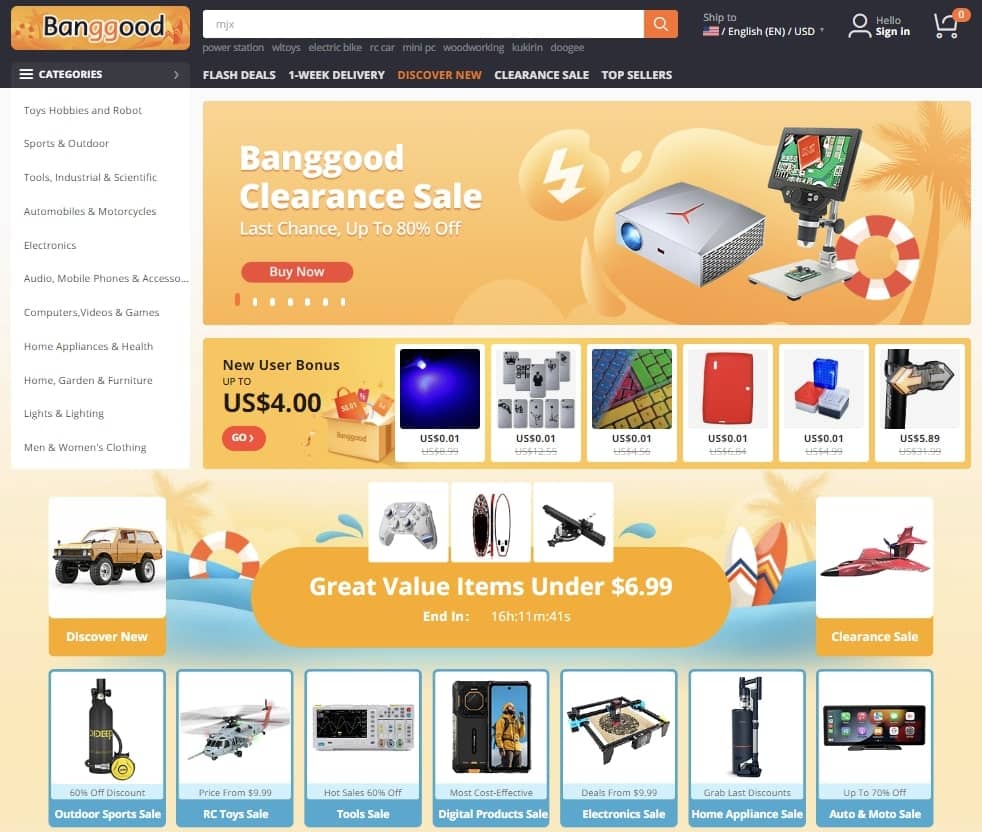
Founded in 2006, Banggood has grown rapidly to become a major player in the e-commerce industry. The company is headquartered in Guangzhou, China, and serves key markets including Europe, the United States, and several regions in Asia.
Banggood’s official website showcases a robust catalog featuring millions of products sourced from more than 100,000 suppliers.
Banggood operates on a direct-to-consumer model, buying products in bulk directly from manufacturers and selling them through its platform. This eliminates the middleman, allowing for lower prices.
The platform specializes in various niches such as electronics, clothing, home appliances, and outdoor gear.
Particularly popular among tech enthusiasts, Banggood also offers a dedicated dropshipping service, enabling small business owners to source products without upfront inventory costs.
This makes it a preferred choice for entrepreneurs looking to enter the e-commerce space.
Pros
- Competitive Pricing: By purchasing goods directly from manufacturers, Banggood can offer products at very competitive prices.
- Express Shipping Options: For customers in Europe and the United States, Banggood’s express shipping ensures delivery within 6-10 business days.
- Wide Range of Products: The platform offers over 500,000 different products across various categories, providing extensive choices.
- Reliable Customer Service: Banggood has a reputation for providing consistent customer service and quality control, ensuring a smooth shopping experience.
Cons
- Limited Product Variety Compared to Competitors: While extensive, Banggood’s product range falls short compared to competitors like AliExpress, which boasts over 100 million products.
- Shipping Delays: Despite express options, standard shipping can sometimes be slower than expected, especially for international orders.
- Higher Risk for Returns: Returning products can be more complicated due to international shipping policies and fees.
- Customer Service Delays: Some users report delays in customer service responses, which can impact the overall shopping experience.
What Is AliExpress?
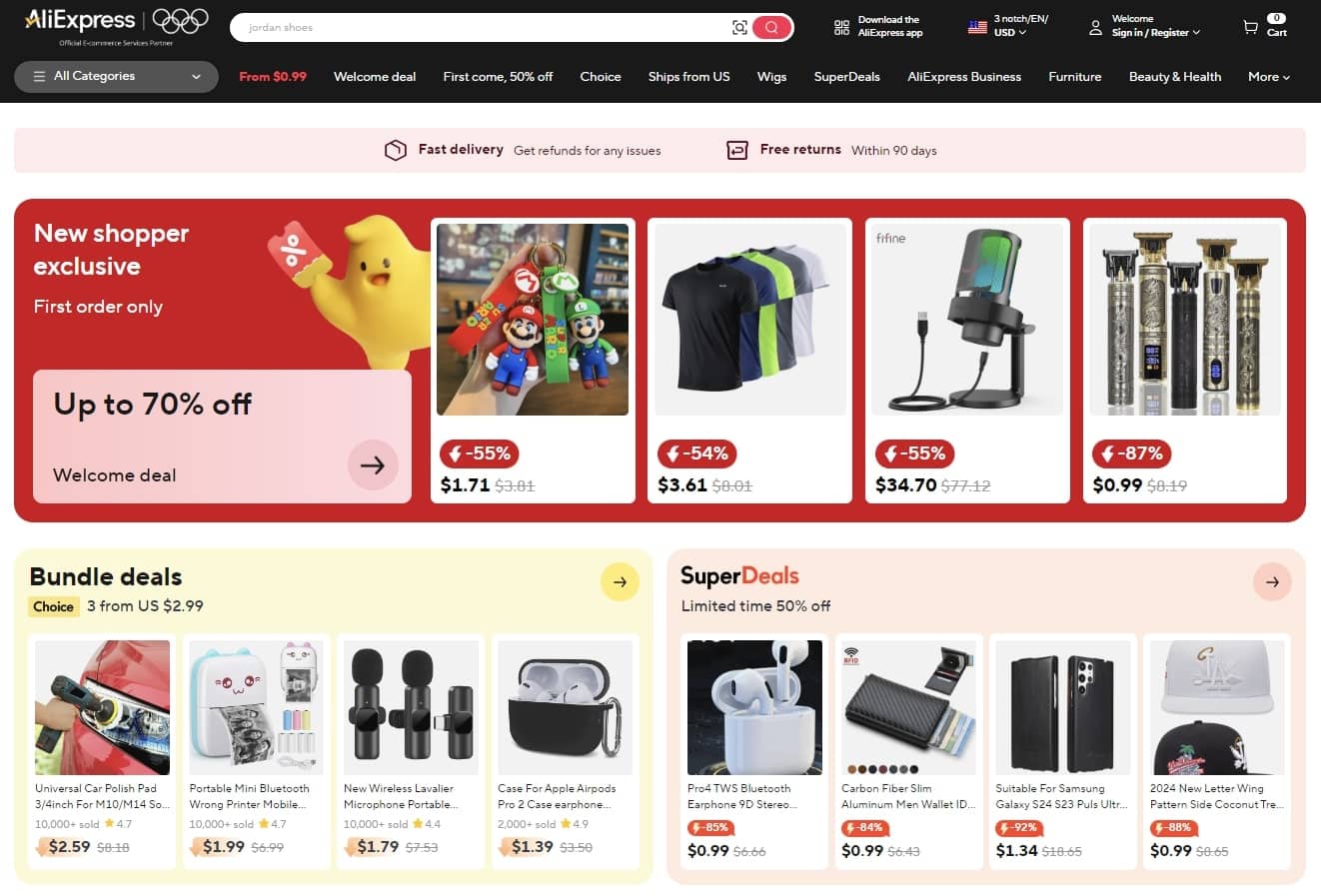
AliExpress was founded in 2010 by the Alibaba Group, one of the largest e-commerce companies in the world. It is headquartered in Hangzhou, China.
AliExpress operates globally, reaching customers in over 220 countries and regions. It provides a platform for small businesses and manufacturers to sell their products internationally.
The marketplace is well-known for its vast selection of items ranging from electronics and fashion to home goods and beauty products.
AliExpress operates as a marketplace where third-party sellers can list and sell their products directly to consumers. The platform specializes in a wide range of products, many of which are sourced directly from Chinese manufacturers.
It caters to a diverse audience, including individual consumers and small business owners looking for products to dropship.
AliExpress’s business model relies heavily on connecting sellers with buyers, offering competitive prices and numerous product options.
Reviews and industry analysis from e-commerce publications highlight its robust supplier network and extensive product variety.
Pros
- Wide Product Range: With over 100 million products, you’ll find almost anything you need.
- Competitive Prices: Prices tend to be lower due to direct manufacturing sources.
- Global Shipping: Ships to over 220 countries, making it accessible worldwide.
- Buyer Protection: Offers programs to protect buyers from fraud and ensure product quality.
- Dropshipping Friendly: Ideal for e-commerce businesses due to ease of sourcing products and low costs.
Cons
- Variable Quality: The presence of numerous third-party sellers can lead to inconsistent product quality.
- Long Shipping Times: International shipping can be slow, often taking weeks to months for delivery.
- Customer Service Issues: Support can be hit-or-miss, with some users reporting difficulties in resolving disputes.
- Scams and Fraud: Requires caution to avoid unreliable sellers and counterfeit products.
- Additional Fees: Some shipments may incur customs fees and taxes depending on the destination country.
Banggood vs AliExpress: Comparison by Features
Table of Summary
| Feature | Banggood | AliExpress |
| Product Variety | 500,000+ products | 100 million+ products |
| Pricing | Direct selling, frequent discounts | Competitive, due to multiple sellers |
| Shipping | 6-10 days express shipping option | Varies widely by seller and method |
| Quality | Consistent quality, direct from Banggood | Varies, seller reviews crucial |
| Customer Service | Managed by Banggood, generally responsive | Varies by seller |
| Mobile App | Popular in Europe, good user experience | Robust, but variable seller interaction |
Product Variety
AliExpress is better for broad product discovery, while Banggood is better for selected product categories like electronics, gadgets, tools, RC products, and hobby items. For dropshippers, this difference matters because the best platform is not always the one with more products. It is the one that fits your niche, shipping expectations, and customer complaint risk.
Banggood
Banggood has a smaller but more focused catalog. It is especially known for categories such as:
- Electronics
- Gadgets
- Tools
- RC cars, drones, and hobby products
- Smart home products
- Outdoor gear
- Home improvement items
- Automotive accessories
This makes Banggood more suitable for niche stores that sell technical, gadget-heavy, or hobby-focused products. For example, if your store focuses on RC parts, compact tools, smart lighting, or tech accessories, Banggood may be easier to browse because the catalog feels more curated.
However, Banggood is less flexible if you are testing random trending products across many categories. You may not find the same depth in fashion, beauty, jewelry, or low-cost impulse-buy products that you can usually find on AliExpress.
AliExpress
AliExpress has a much wider product range because it works as an open marketplace with many independent sellers. You can find products across almost every major dropshipping category, including:
- Fashion and accessories
- Beauty tools and personal care
- Home and kitchen products
- Pet supplies
- Toys and hobby items
- Consumer electronics
- Car accessories
- Fitness products
- Jewelry and lifestyle items
This makes AliExpress stronger for general stores, trend testing, and product research. If you want to test 20 different product ideas before committing to one niche, AliExpress usually gives you more options, more sellers, and more price points to compare.
The downside is that product quality can vary a lot. Two sellers may list the same product with similar photos, but the packaging, material quality, shipping speed, and after-sales support may be different. For dropshippers, that means you need to check seller ratings, recent reviews, product photos, order volume, and delivery estimates before importing anything into your store.
Shipping Speed, Methods & Costs: Side-by-Side Comparison

Banggood can be more predictable when products ship from a local or regional warehouse, while AliExpress gives dropshippers more shipping options because there are more sellers to compare. In both cases, delivery speed depends on the product, warehouse location, seller processing time, shipping method, and destination country.
Banggood vs. AliExpress Shipping Comparison
| Shipping Factor | Banggood | AliExpress |
| Shipping model | More centralized, warehouse-based | Seller-based marketplace shipping |
| Main advantage | Clearer experience for selected products | More sellers and shipping options |
| Local warehouses | Available for some products and regions | Available from some sellers/products |
| Tracking | Usually available, varies by method | Usually available for standard/premium methods |
| Shipping cost | Depends on product, warehouse, and destination | Depends on seller, method, and destination |
| Main risk | Nearest warehouse may not have stock | Seller processing and shipping quality can vary |
| Best for | Gadgets, tools, electronics, hobby products | Broad product testing across many niches |
Which Platform Ships Faster?
Banggood may be faster when the product is already available in a warehouse close to your customer. This can be useful for sellers targeting the US or EU with electronics, tools, RC products, or gadgets.
AliExpress can also be fast, but it depends more on the individual seller. Some sellers offer local warehouse shipping or faster logistics options, while others may take longer to process and dispatch orders.
For dropshippers, the safer approach is to check shipping at the product level. Before listing any item, review:
- Shipping-from location
- Estimated delivery time
- Processing time
- Tracking availability
- Recent reviews mentioning delivery
- Alternative sellers offering the same product
What About Shipping Costs?
Shipping costs vary too much to compare by platform alone. A low AliExpress product price can become less attractive once shipping is added, while a Banggood product may cost more upfront but offer a better warehouse route for certain countries.
The better metric is landed cost, which includes:
- Product price
- Shipping fee
- Processing time
- Refund or reshipment risk
- Customer support burden caused by slow delivery
Practical Takeaway
Use Banggood when the product has a clear warehouse location, reliable tracking, and a delivery estimate that fits your customer expectations.
Use AliExpress when you want more shipping choices and more sellers to compare, especially during product testing.
For scaling, both platforms have limits. Once a product sells consistently, a sourcing agent or fulfillment partner can usually offer better control over shipping lines, QC, packaging, and delivery consistency.
Pricing and Discounts
When comparing Banggood and AliExpress, the differences in pricing, discounts, and promotional offers stand out. Each platform employs unique strategies to attract buyers, and understanding these can help you make a better purchasing decision.
Banggood
Banggood typically features more stable pricing because it eliminates third-party sellers. The platform follows a direct selling model, which results in fixed prices for products. This stability can be a benefit if you value consistency.

Banggood also offers bulk purchase discounts, which can be significant for large orders. For instance, bulk buyers can often negotiate for better rates depending on the order size.
In addition to bulk discounts, Banggood runs various promotional events throughout the year. These events include flash sales, seasonal discounts, and special offers for new users.
For example, during major holidays, you might find sizeable discounts on a wide range of products.
AliExpress
AliExpress, on the other hand, generally offers lower and more competitive prices due to its marketplace model. The presence of numerous third-party sellers drives competition, leading to variations in pricing.
This competition benefits you as a buyer because you can shop around for the best deals.
AliExpress frequently runs promotional campaigns, including daily deals and time-limited offers. During these events, you might find products at a fraction of their original price.
Important sales events like the 11.11 Global Shopping Festival offer substantial discounts across various categories.
Moreover, AliExpress has a loyalty program that rewards frequent buyers. Through the AliExpress Coins program, you can earn coins for purchases, product reviews, and other activities.
These coins can then be redeemed for discounts on future purchases, providing further savings.
Refunds and Returns
When shopping online, knowing the refunds and returns policies of different platforms can save you time and hassle. Here’s how Banggood and AliExpress handle these crucial aspects.
Banggood
Banggood offers a generally standardized return policy. You can return unused products within 30 days, except for hygiene-related items. If a product is defective or damaged, Banggood covers the return shipping cost.
Refunds are processed within 7 business days of receiving the return. You can also easily contact customer support via their website.
Banggood’s return policy page outlines these steps clearly. The benefits include a straightforward process and quicker refunds compared to some competitors.

AliExpress
AliExpress has a variable return policy. Each seller sets their own terms, which can complicate things. If a dispute arises, you can use AliExpress’s dispute resolution service, which mediates between you and the seller.
You might also need to cover the return shipping cost unless specified otherwise. Refunds depend on the seller and can take longer compared to Banggood.
On the plus side, AliExpress provides a buyer protection program that ensures you get a refund if the item is not as described or doesn’t arrive. This program adds a layer of security for your purchases.
Dropshipping
AliExpress is usually the better dropshipping platform for beginners and Shopify product testing, while Banggood can work better for selected gadget, electronics, tools, and hobby niches. The right choice depends on whether you need product variety, faster testing, simpler integration, or more controlled fulfillment.
Banggood for Dropshipping
Banggood can be useful for dropshippers who want a more centralized supplier experience. Instead of dealing with thousands of independent sellers, you are usually sourcing through Banggood’s own platform, which can make product browsing, order handling, and support feel more controlled.
Banggood has also offered dropshipping tools such as product listing support, order fulfillment, and API access for dropshippers. However, sellers should always verify the latest program details directly on Banggood before relying on specific features, discounts, or automation options, because platform programs can change over time.
Banggood is strongest for categories like:
- Electronics
- Gadgets
- Tools
- RC products
- Smart home items
- Hobby products
Its main limitation is flexibility. Compared with AliExpress, you get fewer product choices, fewer third-party app options, and fewer backup suppliers if a product goes out of stock.
AliExpress for Dropshipping
AliExpress remains one of the most common platforms for dropshipping because it has a much larger seller base, broader product catalog, and stronger Shopify app ecosystem. Tools like DSers help sellers import products, place bulk orders, sync tracking numbers, and manage AliExpress suppliers from one dashboard.
This makes AliExpress better for:
- Product testing
- General dropshipping stores
- Trend-based products
- Comparing multiple suppliers
- Finding cheaper alternatives for the same item
The trade-off is consistency. AliExpress is an open marketplace, so product quality, shipping speed, packaging, and seller communication can vary widely. Dropshippers need to vet each seller carefully instead of assuming all AliExpress listings are reliable.
Dropshipping Integration: Which Platform Works Better with Shopify?
AliExpress works better with Shopify for most dropshippers because it has wider app support, easier product importing, and more established order fulfillment workflows. Banggood can still work, but its integration ecosystem is more limited.
AliExpress Shopify Integration
AliExpress is easier for beginners because many Shopify dropshipping apps are built around it. These tools can help you:
- Import products, images, variants, and descriptions
- Place supplier orders
- Sync tracking numbers
- Compare similar products from different sellers
- Test multiple products quickly
The downside is that automation does not remove supplier risk. Shipping speed, product quality, packaging, and seller communication still depend on the individual AliExpress supplier.
Banggood Shopify Integration
Banggood can support dropshipping workflows and has offered features such as product listing support, order fulfillment, and Shopify API access. However, sellers should verify the latest Banggood dropshipping features directly before building their store around them.
Banggood may work better for Shopify stores focused on electronics, gadgets, tools, RC products, or hobby items. The trade-off is that you get fewer third-party tools, fewer supplier alternatives, and less product variety than AliExpress.
Quick Comparison
| Factor | AliExpress | Banggood |
| Shopify app support | Stronger | More limited |
| Product importing | Easier | Possible, but less flexible |
| Order automation | More established | Depends on current tools |
| Product variety | Much broader | More focused |
| Best for | Beginners, testing, general stores | Gadget, electronics, and hobby stores |
| Main risk | Seller quality varies | Fewer tools and supplier options |
Practical Takeaway
Use AliExpress if you want the easiest Shopify setup and faster product testing.
Use Banggood if your niche fits its stronger categories and you are comfortable checking inventory, shipping, and integration options more carefully.
For scaling, Shopify integration is only one part of the decision. Once a product starts selling consistently, a sourcing agent or factory-direct partner can usually give better control over pricing, QC, packaging, and fulfillment.
Customer Service

When choosing between Banggood and AliExpress, it’s important to understand their customer service features. Both platforms offer various support options, but there are notable differences in their approach and effectiveness.
Banggood
Banggood provides customer support through live chat, email, and a comprehensive help center. Many users appreciate the live chat feature for its immediacy, often receiving responses within minutes.
Email support is also available, though responses can take up to 24 hours.
Banggood boasts a 91% satisfaction rate according to user feedback. However, customers have reported mixed experiences when dealing with refunds.
Some users find the process straightforward, while others have faced delays. The customer service page offers detailed FAQs and policies to assist buyers quickly.
AliExpress
AliExpress has a different customer service structure, providing phone support, live chat, and email. Live chat and email are the most commonly used options, with live chat typically offering faster responses.
Phone support adds an extra layer of convenience for immediate inquiries.
User reviews indicate that AliExpress’s customer service is often responsive, although the refund process can be slow. A common complaint is the long time it takes to process refunds if a seller fails to respond within the initial 15-day period.
According to the customer service reviews, AliExpress achieves a 88% satisfaction rate, making it a reliable choice for many shoppers looking for diverse support options.
When to Use Banggood vs. AliExpress (Decision Framework)
Use AliExpress when you need product variety and fast testing. Use Banggood when your niche fits its stronger categories, such as electronics, gadgets, tools, RC products, or hobby items. For long-term scaling, both platforms are usually better for validation than serious brand building.
| Situation | Better Option | Why |
| You want to test many products quickly | AliExpress | Larger catalog, more sellers, and more Shopify app support |
| You run a general dropshipping store | AliExpress | Easier to find products across fashion, beauty, home, pets, accessories, and gadgets |
| You sell electronics, tools, or RC products | Banggood | More focused catalog in technical and gadget-heavy categories |
| You want more supplier options for the same item | AliExpress | Multiple sellers often list similar products at different prices |
| You want a more curated shopping experience | Banggood | Fewer random listings and a more centralized platform feel |
| You care most about lowest product cost | AliExpress | More seller competition can create lower prices, but quality must be checked carefully |
| You care most about predictable fulfillment | Depends | Banggood may be better if stock is in a nearby warehouse; AliExpress may be better if you find a strong seller |
| You want private label or custom packaging | Neither | Direct sourcing or a sourcing agent is usually better |
| You are scaling a proven winning product | Neither | Factory-direct sourcing gives more control over pricing, QC, packaging, and shipping |
Choose AliExpress If…
AliExpress is the better choice if you are still testing products and do not know exactly what will sell. Its main advantage is variety. You can compare multiple sellers, check different price points, import products into Shopify more easily, and replace weak products without much friction.
It is especially useful for beginners, general stores, and stores testing trend-based products. Just remember that each AliExpress seller must be vetted separately. A good listing does not always mean consistent quality, fast dispatch, or reliable customer service.
Choose Banggood If…
Banggood is a better fit if your store focuses on categories where Banggood is stronger, such as gadgets, consumer electronics, tools, RC products, smart home items, and hobby products.
It can also be useful when you prefer a more curated catalog instead of sorting through many independent sellers. However, you may have fewer product choices, fewer Shopify tools, and less flexibility if you need backup suppliers for the same item.
Skip Both If…
Skip both platforms if you are trying to build a serious private label brand, customize packaging, negotiate better bulk pricing, or improve delivery consistency.
At that stage, you need more control than Banggood or AliExpress usually provide. A sourcing agent or factory-direct partner like NicheDropshipping can help with supplier matching, product inspection, branding, packaging, and fulfillment, which becomes more important once your store moves beyond basic product testing.
FAQs on Banggood vs AliExpress
Which Is Better, AliExpress or Banggood?
Choosing between AliExpress and Banggood depends on several factors. AliExpress offers a vast range of products, boasting over 100 million items, thanks to its extensive network of third-party sellers.
This allows for more variety compared to Banggood’s inventory of over 500,000 products.
Banggood tends to offer better quality control and more consistent customer service since all products are sold directly by the company.
Shipping times can also be quicker with Banggood’s express shipping to Europe or the United States, which takes around 6-10 business days. Customer reviews generally indicate more consistent experiences with Banggood’s service.
Is Banggood Older than AliExpress?
Yes, Banggood is older than AliExpress. Banggood was founded in 2006, which makes it one of the older e-commerce platforms in China. AliExpress, on the other hand, was launched in 2010 by the Alibaba Group.
This additional time in the market has allowed Banggood to build a strong base and reputation among online shoppers.
Is Banggood Older than AliExpress?
Yes, Banggood is older than AliExpress. Banggood was founded in 2006, which makes it one of the older e-commerce platforms in China. AliExpress, on the other hand, was launched in 2010 by the Alibaba Group.
This additional time in the market has allowed Banggood to build a strong base and reputation among online shoppers.
Can Banggood be Trusted?
Banggood can generally be trusted, as indicated by user reviews and ratings. The platform is known for strict quality control since it does not rely on third-party sellers.
User reviews often highlight positive experiences with product quality and customer service.
Additionally, Banggood states that it has received various certifications and awards for its trustworthy service.
Banggood also employs security measures such as HTTPS encryption to protect customer data, enhancing its reliability among users.
Before making a purchase, it’s always a good idea to check recent reviews and ratings for the specific products you are interested in.

I have just left AliExpress, I purchased a $700 drone, the shipping company delivered the drone to another person, I opened a dispute including even an audio record from a call to the courier in which they say they delivered the parcel to another person but AliExpress deny the refund.
I ordered a drone at AliExpress but it came without the battery. I opened a dispute but the seller just said that the battery was included. I could get a refund if I paid for the shipping. I ended up buying a battery elsewhere. It’s impossible to get hold of a real person at AliExpress customer “service”.
I have decided to close my Aliexpress account since they do not in fact supply any kind of guarantee for delivery, unlike their claim. They have chosen the cheapest lousiest shipping company in Israel “Chita Delivery”, which makes the products disappear, or “deliver” them to unobtainable destination. Aliexpress demand a proof that you didn’t get your shipping, that means the shipping company, who ignores its customers is supposed to confirm that they didn’t deliver. If that isn’t stupid and evil, I don’t know what is. Since these two are in cahoot to cheat customers out of their money without delivering the goods, I see no reason to continue shopping with Aliexpress. I hope that Bangood has a better shipping solution.
I bought a pair of hearing aids via aliexpress which turned out to be faulty (not charging ) raised a complaint and got a return label in 5 minutes
I wont use AliExpress any more. I ordered a £345 musical instrument and got an empty box! refused refund and because AliExpress refused the Refund PayPal refused it too. After several years using AliExpress with no problems, the first time I order an expensive item I get scammed. I even tried to report it to the Police and they don’t want to know. Am using Banggood now with fingers crossed!